
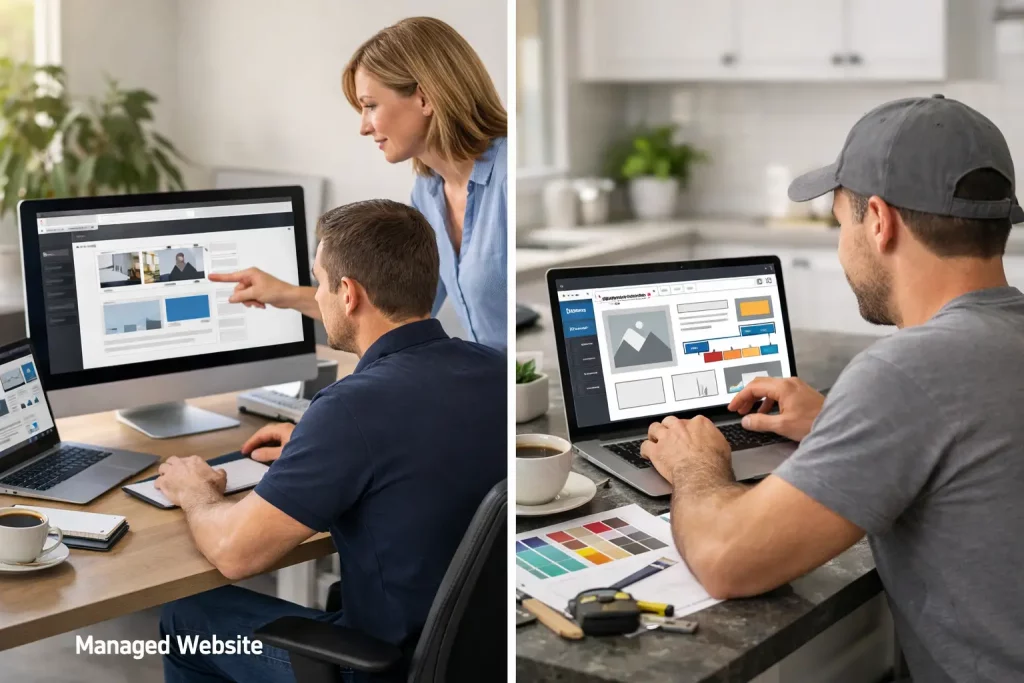
Most trades businesses do not need a website project. They need a website that goes live quickly, looks trustworthy on a mobile phone, and gives customers an easy way to call or ask for a quote. That is what makes the managed website vs DIY builder choice worth getting right from the start.
A lot of tradespeople begin with a builder because it looks cheap, fast and simple. Pick a template, add a few photos, write a bit of text, press publish. On paper, that sounds fine. In practice, many DIY sites sit half-finished for weeks, never quite look right, and do not bring in many enquiries because the important bits get missed.
A managed website is different. Instead of giving you a platform and leaving you to work it out, it gives you the finished result and the ongoing support behind it. For a busy plumber, electrician, roofer or builder, that difference matters more than most people realise.
Managed website vs DIY builder: what is the real difference?
The simplest way to look at it is this. A DIY builder gives you tools. A managed website gives you a working site and someone to keep it running.
With a builder, you are responsible for design choices, page layout, wording, images, forms, mobile setup, updates, hosting and all the little issues that appear once the site is live. Even if the platform is marketed as easy, you still need time to make decisions and fix mistakes.
With a managed service, those jobs are handled for you. The site is built around what your business actually needs – clear service pages, contact options, quote forms, local credibility and a professional look. Ongoing updates, hosting and basic site management are part of the service, so you are not left patching things together later.
That does not mean DIY builders are useless. They can be a decent fit for someone who enjoys doing their own admin, has spare evenings, and is happy to keep learning the platform. But most trades business owners are not short on jobs because they lack a website hobby. They are short on time.
Why DIY often costs more time than money
DIY builders are usually sold on affordability. The monthly price can look low, especially compared with a large one-off web design quote. But the real cost is often your own time.
Every hour spent choosing fonts, resizing photos, testing contact forms or trying to make the mobile version behave is an hour not spent quoting, invoicing or doing paid work. If your website stalls halfway through, the cost is not just frustration. It is lost enquiries from people who could not find you, could not work out what you do, or gave up because your site looked unfinished.
There is also the issue of decision fatigue. A builder gives you endless options, but that is not always helpful. More control sounds good until you are trying to decide between dozens of templates when all you really want is a site that helps people book your service.
For local trades, simple usually wins. Customers are not looking for clever design. They want to know who you are, what work you do, where you cover, and how to get in touch. The longer it takes to create that, the less useful the builder becomes.
What a managed website does better for local trades
A managed service works best when the goal is straightforward: get online quickly and turn visits into enquiries. That suits trades businesses because most customers make fast decisions. They search on their mobile phone, compare a few options, and contact the one that looks credible and easy to reach.
A managed website is built with that behaviour in mind. The layout is usually cleaner, the contact details are more obvious, and the quote form is there for a reason rather than added as an afterthought. It is less about personal taste and more about helping the customer take the next step.
That matters if you depend on local work. A weak site does not just look less professional. It can make a good business appear harder to trust. If a homeowner lands on a clumsy site with missing text, odd formatting or no clear call button, they may simply go elsewhere.
There is also the ongoing side of things. Websites are not fully done the day they launch. Details change. Forms need checking. Hosting needs managing. Small updates need making. If you are using a DIY platform, all of that still sits with you. With a managed setup, someone handles the background jobs so the site keeps doing what it should.
When a DIY builder can still make sense
There are cases where a builder is the right choice. If you are just testing a side business, have a very tight budget, and are happy to do everything yourself, it can be a reasonable short-term option. The same goes if you already have good digital skills and genuinely want full control.
But even then, be honest about what you are buying. You are not buying a finished business tool. You are buying software and a list of tasks.
That distinction matters because many people start with a builder expecting quick results, then end up with a site that is live but not effective. It exists, but it does not really help the business. A phone number buried in the footer, service pages that say very little, or forms that no one tests properly can quietly reduce the number of enquiries coming through.
So yes, DIY can work. It just works best for owners who want another job on their plate.
The key trade-off in managed website vs DIY builder
The main trade-off is control versus convenience.
A DIY builder gives you complete control over the site. You can change layouts, add sections, rewrite pages and keep tweaking whenever you like. For some people, that freedom is useful. For others, it becomes a distraction that delays launch and keeps the site in a constant state of “nearly finished”.
A managed website gives you less day-to-day tinkering, but far more certainty. The site gets built, launched and maintained without you having to become the project manager. That is often the better trade for a business owner whose priority is more enquiries, not more website decisions.
There is also a difference in accountability. If a DIY site underperforms, the responsibility is yours. If a managed site is part of a service, there is someone behind it whose job is to keep it working properly. That peace of mind is worth a lot when you are already juggling customers, paperwork and jobs on site.
What trades businesses should actually choose
If your main goal is to save every possible pound and you are willing to spend your own time learning, building and maintaining the site, a DIY builder may be enough.
If your main goal is to look professional quickly, make it easy for customers to contact you, and avoid another admin task, a managed website is usually the better decision.
That is especially true for sole traders and small teams. You do not need a complicated online setup. You need a dependable one. Something that covers the basics properly, works on mobile, supports local visibility and gives customers confidence to get in touch.
That is why services built for trades tend to make more sense than general website platforms. The site is shaped around how your customers behave and what your business needs, not around endless design choices you never asked for. Trade Sites UK is a good example of that approach – quick setup, simple monthly pricing and no need to handle the technical side yourself.
A website should take work off your hands, not create more of it. If the idea of building your own site already feels like another unfinished evening job, that is probably your answer.
Choose the option that gets you online properly and keeps you there. The best website is not the one with the most features. It is the one that helps the next customer call, message or request a quote without thinking twice.