
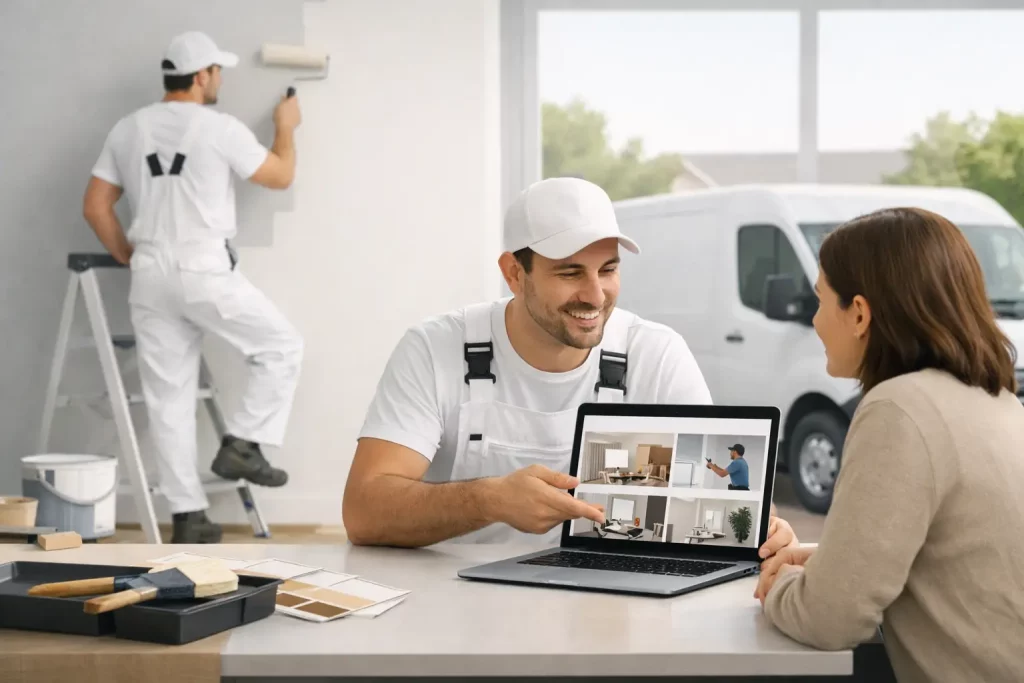
Most painting and decorating jobs are won before you ever pick up the phone. A customer searches online, checks a few businesses, looks at past work, and makes a quick judgement. If your website for painter decorator services looks dated, says very little, or makes it awkward to get a quote, you can lose the job to someone less experienced but easier to trust.
That is the real job of a trade website. It is not there to impress other designers. It is there to help local customers feel confident enough to contact you.
Why a website for painter decorator businesses matters
A lot of decorators still get work through word of mouth, and that can work well for a while. The problem is that referrals are inconsistent. Some months are busy, some are quiet, and you are left hoping the next recommendation comes through at the right time.
A website gives you something more dependable. It helps customers find you when they are actively looking, whether they need a full house repaint, exterior work, wallpapering, or a decorator for a rental refresh. It also gives people a place to check that you are legitimate. Even if they heard about you from a neighbour, many will still look you up before getting in touch.
There is also a simple credibility point here. A painter and decorator is selling finish, care, and attention to detail. If your online presence feels neglected, customers notice the mismatch.
What customers want to see before they enquire
Most visitors are not reading every line. They are scanning for proof that you do the kind of work they need, in the area they live, at a standard they are happy to pay for.
That means the right website needs to be clear straight away. Your service area should be easy to spot. Your main services should be obvious. Your phone number and quote form should be simple to find on a mobile phone. And your past work should do a lot of the heavy lifting.
Photos matter more for decorators than for many other trades. People want to see clean lines, tidy finishes, careful prep, and the kind of spaces you normally work on. Domestic customers may want to see living rooms, hallways, bedrooms, kitchens, and exterior walls. Commercial clients may care more about neat delivery, consistency, and reliability. If you work across both, your website should make that clear without becoming cluttered.
Reviews also help, but only if they feel believable and relevant. A short, specific review about a staircase repaint or full interior job is stronger than vague praise.
The pages a painter decorator website actually needs
A good website for painter decorator firms does not need to be complicated. In most cases, a small number of solid pages will do the job better than a bloated site full of filler.
Your homepage should explain who you are, what you do, where you work, and how to request a quote. It should quickly reassure people that they are in the right place.
A services page should cover the main jobs you want more of. That may include interior painting, exterior painting, wallpaper hanging, woodwork painting, mist coating, rental property refreshes, and commercial decorating. Not every decorator offers all of these, so the site should reflect your actual work rather than trying to sound broad for the sake of it.
A gallery or past work section is essential. This is one of the strongest trust signals you have. Before and after images can work well if the quality is decent and the examples are relevant.
A contact page should do one thing well – make it easy to enquire. Phone number, form, service area, and perhaps preferred contact times are usually enough.
Some businesses also benefit from an about page. For a sole trader or small team, this can help customers feel they are dealing with a real local professional rather than a faceless company. It only works if it stays straightforward.
What makes one website convert better than another
Two decorators can offer the same standard of work, but one will often get more enquiries because the website removes friction.
The first thing is mobile use. Most customers will find you on their mobile phone, not on a desktop computer. If they have to pinch, zoom, or hunt around for the contact button, a good number will give up.
The second is speed. People are impatient, especially when comparing several local businesses. Slow pages, awkward layouts, or forms that ask for too much information can cost you leads.
The third is clarity. Customers should not have to work out whether you take on domestic jobs, whether you cover their area, or whether you handle the type of decorating they need. If the answer is yes, say it clearly.
The fourth is reassurance. Simple trust signals matter. Real project photos, clear service areas, sensible wording, and easy contact details all help. Flashy effects do not.
A common mistake with a website for painter decorator services
The most common mistake is treating the website like an online brochure and then forgetting about it. A site launched once and left untouched for years often ends up with old photos, stale wording, broken forms, or the wrong phone number. Even when the work quality is excellent, the business can look inactive.
Another mistake is trying to say too much. Some decorators list every possible service, every product they have used, and long blocks of text that no customer will read. More content is not always better. Better structure is better.
There is also the issue of lead platforms and social media. They can bring work, but they are not assets you control. A lead site can change prices. A social platform can limit reach. Your own website is where customers come to deal with you directly, on your terms.
Should you keep it simple or add more detail?
This depends on the type of work you want.
If you mainly take on straightforward domestic painting and decorating in a defined local area, a clean and simple site is usually best. Customers in that market often want quick reassurance and an easy way to ask for a price.
If you are targeting larger commercial or higher-value residential projects, you may need a bit more detail. That could include stronger project examples, more information about the type of properties you work on, and a more polished explanation of your process.
The trade-off is that more detail can help qualify better enquiries, but too much can slow people down. Most small decorating businesses benefit more from clarity and speed than from trying to cover every angle.
What ongoing management really matters
A website is not a one-off task if you want it to keep bringing in work. It needs basic upkeep. That means your forms should keep working, your hosting should stay reliable, your images should reflect recent jobs, and your business details should remain current.
For busy tradespeople, this is where things often fall down. You are on site, quoting, ordering materials, and managing jobs. The website gets pushed down the list because there is always something more immediate to deal with.
That is why a managed service makes sense for many decorating businesses. Instead of building a site and then worrying about updates, fixes, setup, and ongoing admin, you get something that is live quickly and kept in working order. For a business focused on winning more local enquiries, that is usually more useful than having full control over technical details you do not want to touch.
Trade Sites UK is built around that practical approach – simple websites for trades, launched quickly, managed properly, and designed to make it easier for customers to get in touch.
How to judge whether your current site is doing its job
A website does not need loads of traffic to be worthwhile. It needs the right visitors and a clear route to contact.
Ask yourself a few plain questions. Does it look professional on a mobile phone? Can a customer tell what areas you cover within a few seconds? Does it show real decorating work? Is there a clear quote form or phone number on every key page? Are you getting genuine enquiries from it, not just visits?
If the answer to several of those is no, the problem is probably not your trade. It is the way your business is being presented online.
A strong website for painter decorator businesses should quietly do the sales work in the background. It should help the right customers trust you, see the standard of your work, and take the next step without hesitation.
You do not need a complicated online setup to win more decorating jobs. You need a site that looks professional, works properly on mobile, and gives local customers an easy reason to choose you.