
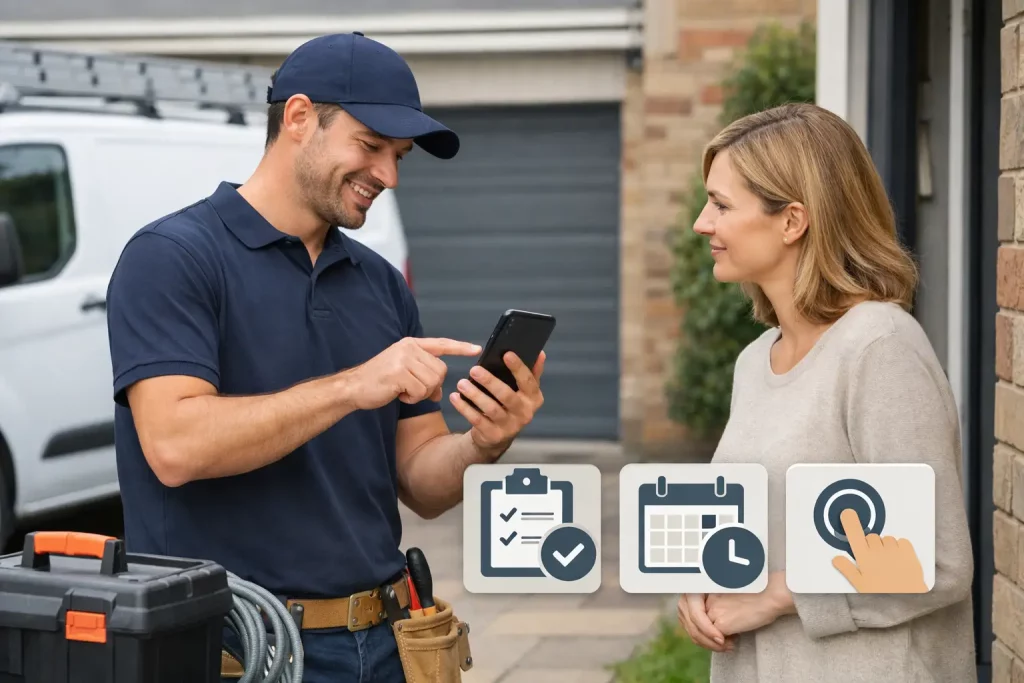
A customer has found your business, checked that you cover their area and decided you look like the right person for the job. At that point, the best call to action for tradesmen is not clever wording. It is a clear instruction that makes getting in touch feel quick and easy.
If a homeowner has a leaking pipe, faulty socket or roof repair to sort, they do not want to hunt around a page wondering what happens next. They want to call, send a message or ask for a quote. Your website should make that next step obvious on every screen, especially on a mobile phone.
What makes a call to action work for a trade business?
A call to action, often shortened to CTA, is the button, link or line of text that asks a visitor to do something. For a local trades business, that usually means making an enquiry.
The strongest CTAs are specific. “Get Started” may suit an online service, but it tells a homeowner very little. “Request a Free Quote”, “Call for a Same-Day Visit” or “Book Your Boiler Repair” gives them a clear reason to act and sets the right expectation.
It also needs to match the job and how your customers behave. A customer with an emergency plumbing issue is likely to call. Someone planning a kitchen renovation may prefer to send details and photos first. One button cannot do every job equally well.
The best call to action for tradesmen is usually “Request a Quote”
For most non-emergency work, “Request a Quote” is the safest and most effective main CTA. It is plain English, familiar to homeowners and does not overpromise a fixed price before you have seen the work.
It works well for builders, landscapers, carpenters, plasterers, painters, roofers and electricians quoting for planned jobs. It also gives visitors a simple route forward when they are comparing a few local firms.
Use it in the main banner at the top of your homepage, at the end of service sections and on your contact page. Keep the wording consistent. If the main button says “Request a Quote”, do not then call the same form “Start Your Project” elsewhere. Consistency helps busy customers act without thinking.
There are situations where a more direct CTA will win more enquiries. For urgent work, “Call Now for Emergency Repairs” is better because it reflects what the customer needs. For services that can be scheduled easily, such as a boiler service or electrical inspection, “Book an Appointment” may be more suitable.
The point is to choose one main action based on the kind of jobs you want, then make that action easy to take.
Match the CTA to the customer’s job
Your wording should answer the question a potential customer has in their head: “What can I do here?” A vague button adds hesitation. A job-specific one removes it.
For urgent or emergency work
Use action-led wording that encourages a phone call. “Call Now”, “Speak to a Plumber” and “Call for Emergency Help” work because speed matters more than a detailed form.
Only use emergency language if you can genuinely respond quickly. Promising 24-hour help when calls go unanswered overnight will cost trust as well as enquiries.
For quotation work
“Request a Quote” is the dependable choice. If you offer free quotations, “Get a Free Quote” can work too, but only say it when there is no charge for the visit or estimate. Customers notice when the wording and the reality do not match.
For larger projects, “Tell Us About Your Project” can be a useful secondary CTA. It feels less transactional and encourages people to share useful details before you arrange a visit.
For booked services
Where the service is straightforward, use “Book Your Service”, “Arrange a Visit” or “Book a Survey”. These phrases make the next step feel organised without implying that the work is already confirmed.
Heating engineers, electricians and maintenance businesses often benefit from this approach. Just make sure the enquiry process explains whether you will call back to confirm a time.
Put the right CTA where customers can see it
Good wording will not help if the button is buried halfway down the page. Your phone number and main enquiry button should be visible near the top of the page, before visitors have to scroll through long blocks of text.
On mobile, a click-to-call button is particularly useful. Many local customers search while standing in their kitchen, at work or on the way home. If they need to copy a number, swap apps and come back later, some will not bother.
Repeat the main CTA naturally after important information. For example, after a section explaining your roofing repairs, add a short line such as: “Need a roofer to inspect the problem? Request a quote and I will get back to you.” This is helpful, not pushy, because it appears when the reader is ready to decide.
A page should not be covered in competing buttons. If one says “Call Now”, another says “Get Started” and a third says “Learn More”, visitors have to choose a route. Keep one primary action, then offer a sensible alternative such as a phone number for people who prefer to speak to someone.
Make the enquiry process feel low effort
The CTA gets the click, but the form or contact method must finish the job. A form asking for too much information can lose good leads. For most trades businesses, name, phone number, postcode, a short description of the work and an optional photo upload are enough to begin.
Explain what happens next close to the button or form. A simple line such as “Send your details and I will contact you to discuss the job” reassures people that they are not committing to anything unexpected.
Response time matters too. You do not need to promise an exact number of minutes if that is unrealistic, but customers should know you will reply. If you are often on site, say that you will return calls as soon as possible. Clear expectations are better than silence.
Avoid calls to action that create doubt
Some common CTA phrases sound polished but do not suit a local trade service. “Submit” feels cold and gives no clue what happens after the click. “Contact Us” is acceptable as a navigation label, but it is weaker as the main sales button because it is not tied to an outcome.
Be cautious with “Get a Price”. For many jobs, you cannot give an accurate price without seeing the issue, measuring up or discussing materials. “Request a Quote” is more honest and less likely to attract arguments over an estimated figure.
Avoid pressure tactics as well. Phrases like “Act Fast” or “Don’t Miss Out” rarely fit a business built on trust, unless there is a genuine limited-time offer. Homeowners are looking for a reliable person to let into their property, not a hard sell.
Use one clear promise, then let customers act
The best CTA does not need to carry your whole sales message. The page around it should show the services you provide, the areas you cover and why people can rely on you. The button simply turns that confidence into an enquiry.
For many local trades businesses, a professional site with a clear “Request a Quote” button and an easy way to call is enough to make a real difference. Trade Sites UK is built around that straightforward route: help local customers find you, understand what you do and get in touch without hassle.
Choose the CTA that suits the work you want more of, make it visible on every device and make sure somebody follows up. A clear next step will always beat a clever one.