
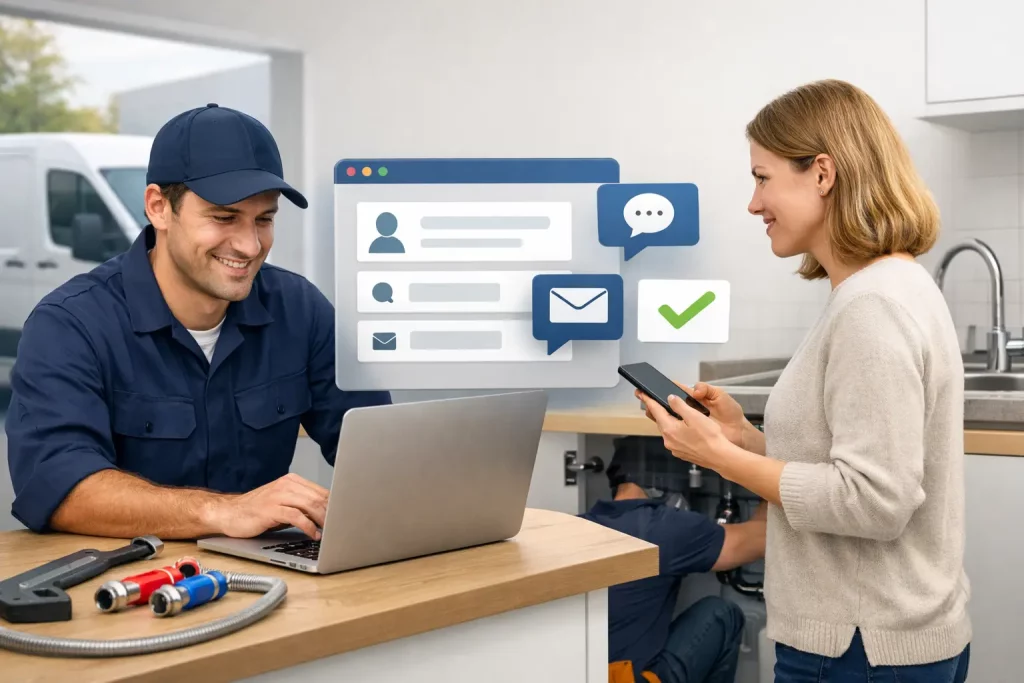
Most plumbing websites do not have a traffic problem. They have an enquiry problem. People land on the site, look around for a few seconds, then leave without calling or filling in a form. If you want to know how to improve plumber website enquiries, the answer is usually simpler than most plumbers expect. Make it easier for the right customer to trust you and contact you quickly.
A homeowner with a leak or no hot water is not reading your website for entertainment. They want to know three things straight away. Do you cover their area, do you do the job they need, and how fast can they get hold of you? If your site makes them work to find that out, enquiries drop.
Why plumbers lose enquiries on otherwise decent websites
A lot of plumber websites look acceptable at first glance. They might have a logo, a few photos, and a contact page. The problem is that looking professional is only part of the job. Your website needs to move visitors towards action.
That means the layout, wording and contact options need to match how real customers behave. Most people visit on a mobile. Many are in a rush. Some are comparing two or three local plumbers at once. If your number is hard to tap, your service areas are unclear, or your quote form asks for too much, they will move on.
There is also a trust issue. Plumbing is a service people often need urgently, but they still want reassurance before getting in touch. If your website feels thin, outdated or vague, it creates doubt. Even if you do great work, the site may be telling a different story.
How to improve plumber website enquiries without overcomplicating it
The best improvements are usually not flashy. They are practical changes that remove friction.
Start with your homepage. It should say what you do, where you work and how to contact you in the first screen view on a phone. A visitor should not have to scroll to work out whether you handle boiler issues, emergency leaks, bathroom plumbing or general plumbing repairs. Be specific. “Plumber in Leeds” is more useful than a vague line about quality services.
Your phone number should be visible at the top and easy to tap on mobile. If calling is the main action you want, treat it like the main action. Do not hide it in a menu or only place it on the contact page.
At the same time, not everyone wants to call straight away. Some people are at work, some are comparing quotes, and some prefer to send details first. That is why a short quote form matters. Name, phone number, postcode and job details are usually enough. If your form asks for too much, completion rates often fall.
Build pages around actual services
One of the quickest ways to improve plumber website enquiries is to stop relying on a single general services page. Customers search for specific problems. They do not always search for “plumber” on its own.
If you offer leak repairs, blocked drains, radiator work, shower installation, toilet repairs or emergency call-outs, those should be clearly mentioned on your site. In many cases, separate service pages work better because they make the match clearer between what the visitor needs and what your business provides.
This also helps with conversion, not just visibility. A page about boiler pressure problems or burst pipes feels more relevant to someone dealing with that exact issue. Relevance builds confidence.
There is a balance here. You do not need dozens of thin pages with barely any useful content. A smaller number of well-written service pages is usually better than a long list of vague ones.
Show where you work clearly
A lot of local trade websites lose enquiries because they are too vague about coverage areas. People want to know if you serve their town before they bother contacting you.
If you cover a city and nearby towns, say so clearly. Put your service areas in sensible places across the site, not buried in a footer nobody reads. If someone lands on your page and sees their area mentioned, it gives them a reason to stay.
This matters even more for plumbers because response time can affect the enquiry. If a customer thinks you might be too far away, they will often choose another local option without checking.
Trust signals do more work than clever design
For a plumbing website, trust wins more enquiries than style. A clean site helps, but proof matters more.
Reviews are one of the strongest signals you can use. They show that real customers have used you and were happy with the result. Keep them short, readable and relevant. If a review mentions punctuality, fixing a leak quickly or leaving the job tidy, even better. Those details feel real.
Photos also help, especially if they look genuine rather than copied from stock libraries. A tidy van, completed bathroom work, new radiators or pipework can all reinforce credibility. You do not need a gallery full of polished marketing images. You need enough to show that you are active and professional.
If you have qualifications, accreditations or public liability insurance, include them where relevant. Do not overdo it, but do not assume people will simply trust that you are established.
Make mobile the priority
Most local service enquiries now come from phones. That means your site needs to work properly on mobile first, not as an afterthought.
A mobile-friendly plumber website should load quickly, keep text readable, and make the main actions obvious. Buttons should be easy to tap. Forms should be short. Contact details should be visible without hunting around.
If your website is slow, cluttered or awkward on a mobile phone, that hurts enquiries. It is not just annoying for the visitor. It creates doubt about the business itself. People often judge reliability from small things.
This is one reason simple websites often outperform more complicated ones. They do the job faster.
Give people a reason to contact you now
Some plumber websites explain the business but do not create any urgency. They tell visitors what the company does, but not why they should get in touch today.
You can improve this by using straightforward calls to action throughout the site. Tell people exactly what to do next. “Call now for a fast quote” or “Send your job details and I will get back to you” works because it is clear.
It also helps to set expectations. If you usually respond quickly, say that. If you offer same-day call-outs in certain cases, mention it. If you provide free quotes for planned plumbing work, make that obvious. Clear expectations reduce hesitation.
Just keep it honest. If you cannot offer 24-hour response, do not imply that you can. The goal is more enquiries from the right customers, not more frustration.
Common mistakes that quietly reduce enquiries
A few issues come up again and again on trade websites.
The first is too much waffle. Customers do not need long blocks of generic text about quality workmanship and customer satisfaction. They need clear information about services, areas covered and how to contact you.
The second is poor contact journeys. If the only way to get in touch is a hard-to-find contact page, you are making it harder than it needs to be. Your number and enquiry options should appear across the site.
The third is neglect. An outdated website with broken forms, old photos or missing pages does real damage. Even a decent site will stop producing if it is not maintained. This is where many trades businesses get stuck. The website goes live, then nobody updates it, checks forms or keeps things running properly.
That is one reason managed services appeal to busy tradespeople. If someone else handles the setup, hosting, updates and forms, the site is far more likely to keep doing its job. For a plumber who would rather be on site than dealing with website admin, that matters.
What to fix first if enquiries are low
If your website is getting visits but not many leads, start with the basics before making bigger changes.
Check whether your main services are clear within seconds. Check whether your phone number is visible and tappable. Check whether your form is short and working properly. Check whether your areas are clearly listed. Then look at trust. Reviews, genuine job photos and a professional layout often make a noticeable difference.
After that, look at the pages that matter most. Your homepage, contact page and service pages should do most of the heavy lifting. If those pages are weak, adding more content elsewhere usually will not solve the problem.
For many plumbers, the best-performing websites are not the biggest or most expensive. They are the clearest. They help the customer feel confident and make contacting the business easy.
How to improve plumber website enquiries over time
Once the foundations are right, improvement becomes a matter of consistency. Keep reviews coming in. Add new job photos from time to time. Make sure service information stays accurate. If you expand to a nearby area or add a new service, reflect that on the site.
You do not need to turn your website into a full-time marketing project. You just need it to stay current, trustworthy and easy to use. Trade Sites UK builds websites around exactly that principle – simple, managed websites designed to help local trades get more enquiries without extra hassle.
A plumbing website does not need to impress other plumbers. It needs to help a customer with a problem choose you quickly and with confidence. When that becomes the focus, more enquiries usually follow.