
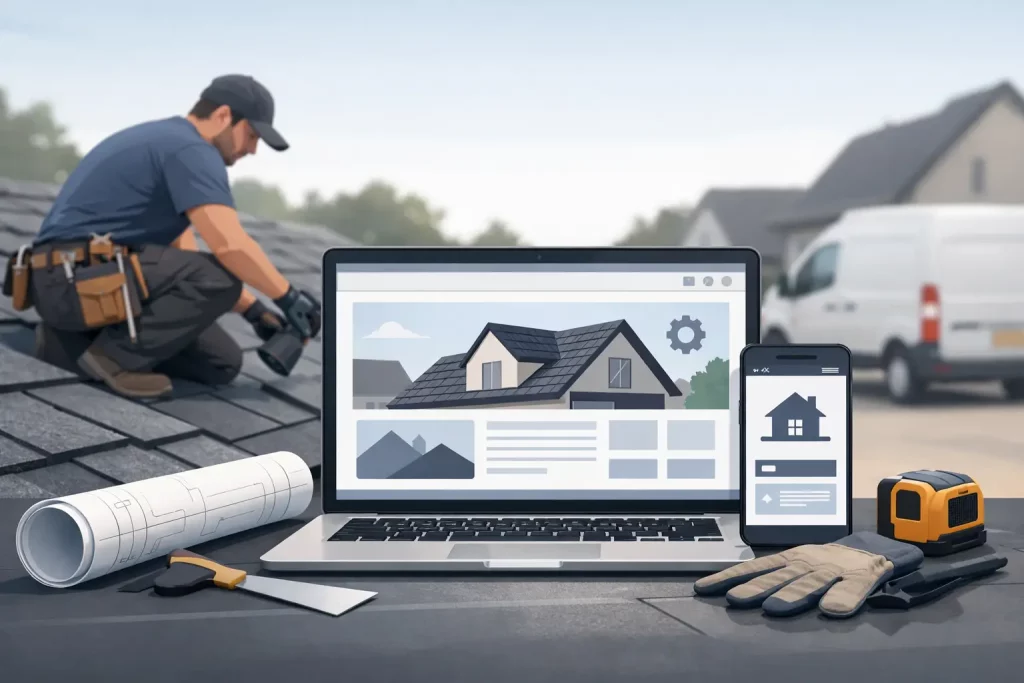
A roofer can do excellent work, have years of experience, and still lose enquiries to a competitor with a clearer website. That is the real reason a guide to websites for roofers matters. Most customers are not comparing flashing details or felt systems online. They are deciding who looks reliable, local, and easy to contact.
If your website does not answer those questions quickly, people move on. They ring the next firm, fill in the next form, or go back to Google. A roofing website does not need to be clever. It needs to help the right customer feel confident enough to get in touch.
What a roofer’s website is actually there to do
A roofing website is not a brochure for the sake of it. It is there to bring in local quote requests, phone calls, and messages from people who need roofing work done. That might be a leaking roof, a full replacement, chimney repairs, flat roofing, fascias and soffits, or emergency call-outs.
That means the job of the site is simple. It should show what you do, where you work, and how to contact you. It should also give enough proof that you are a legitimate business worth calling.
Many roofers overthink this part. They assume they need lots of pages, lots of wording, or something custom-built. In reality, most small roofing firms need a straightforward site that loads properly on a phone, looks professional, and makes requesting a quote easy.
Guide to websites for roofers: what must be on the site
If a roofing website is missing the basics, it will struggle no matter how smart it looks. A customer landing on your site should be able to understand your business in seconds.
Start with a clear homepage. That page should say what you do and the areas you cover without making people hunt for it. If you are a roofer in Leeds, Sheffield, or nearby towns, say so plainly. Local customers want to know they are in the right place straight away.
You also need service pages that match the work you actually want more of. If you handle roof repairs, new roofs, flat roofs, guttering, leadwork, and emergency roofing, those should not be buried in one long block of text. Separate service sections help customers find the right information and make the site clearer.
A contact page matters just as much as the homepage. Phone number, enquiry form, service area, and business details should be easy to find. Plenty of roofers make the mistake of hiding contact information or only listing a mobile number at the bottom of the page. That creates friction, and friction costs enquiries.
Photos are another basic requirement. Roofing is visual work. Customers expect to see examples of completed jobs, not stock images of houses and hard hats. Real job photos build trust quickly, even if they are simple.
Then there is proof. Reviews, years of experience, guarantees if you offer them, and any relevant accreditations all help. You do not need to overdo it, but you do need enough to reassure someone who has never heard of you before.
What makes roofing websites convert better
A good-looking website is not always a useful one. For roofers, the websites that perform best are usually the ones that remove doubt and make the next step obvious.
The first thing is mobile usability. A lot of roofing searches happen on a phone, often when someone has noticed a problem and wants help quickly. If the site is slow, awkward, or hard to tap through, they will leave. Big buttons, clear text, and simple navigation matter more than design flourishes.
The next thing is the quote journey. If someone wants a roofing quote, the path should be obvious. A call button, a short enquiry form, and repeated prompts to get in touch can make a real difference. Long forms asking for too much information tend to reduce enquiries. For most roofers, name, contact details, postcode, and a short description of the job are enough.
Clear wording also matters. Customers are not looking for polished marketing language. They want to know if you can help, whether you cover their area, and how quickly they can speak to someone. Straight answers beat clever copy every time.
There is also a trust factor specific to roofing. People know roofing jobs can be costly and urgent. That means they are naturally cautious. If your website feels vague, outdated, or unfinished, it can put them off even if your work is solid. A clean and current site helps you look established.
The common mistakes roofers make with websites
A lot of roofing websites fail for the same reasons. Not because the business is poor, but because the site does not do the practical job it needs to do.
One common mistake is relying on a single page with very little information. That might seem quick to set up, but it often leaves too many gaps. Customers want enough detail to feel comfortable contacting you.
Another mistake is making the website about the business instead of the customer. Long paragraphs about company history are less useful than clear information about services, areas covered, and how to request a quote. Background matters, but only after the basics are covered.
Some roofers also let websites go stale. Old photos, broken forms, outdated phone numbers, and missing updates send the wrong message. If the site looks neglected, people may assume the business is the same.
Then there is overcomplication. Too many pages, too much text, or fancy design elements can get in the way. Roofing customers are not browsing for entertainment. They want a dependable firm and a quick way to make contact.
How to judge whether your roofing website is working
The best test is not whether you like the design. It is whether the site brings in relevant local enquiries.
Ask yourself a few practical questions. Are people calling from the website? Are quote forms being submitted? Do customers mention finding you online? Can someone landing on the site immediately tell what work you do and where you work?
If the answer is no, the website may be underperforming even if it looks acceptable. That does not always mean it needs rebuilding from scratch. Sometimes the issue is simpler – unclear messaging, poor layout, missing service pages, or weak contact options.
It also depends on your business stage. A sole trader covering one main area may need a smaller site than a roofing company serving multiple towns with a wider set of services. The important thing is fit. The website should match how your business actually wins work.
A practical guide to websites for roofers who want less hassle
Most roofers do not want to manage hosting, updates, forms, and technical issues. Fair enough. You are busy doing the actual work, pricing jobs, and dealing with customers. The website needs to support the business, not become another task sitting on the list.
That is why the best setup for many roofing firms is one that stays simple and managed. A professional website only helps if it stays live, works properly, and continues giving customers an easy way to get in touch.
A monthly service model suits a lot of trades businesses because it removes the usual friction. Instead of paying a large upfront cost and then being left to figure the rest out, you get a site launched quickly and kept in order. That is often more useful than owning a complicated website you do not have time to manage.
For roofers, speed matters too. If your current site is poor or you do not have one at all, every week without a proper online presence can mean missed enquiries. A simple, trade-focused website that can go live quickly is often the better business decision than waiting months for something overdesigned.
What a strong roofing website should leave people thinking
When someone leaves your website, the reaction you want is straightforward. They should think this looks like a proper roofing business, these are the services I need, they cover my area, and I can contact them easily.
That is the standard. Not flashy. Not complicated. Just clear, credible, and built around generating enquiries.
If your website can do that consistently, it becomes more than an online placeholder. It becomes a dependable part of how you win work locally, without relying only on referrals or paying to chase every lead elsewhere.
A good roofing website should make your business easier to choose. If it does that, it is doing its job.