
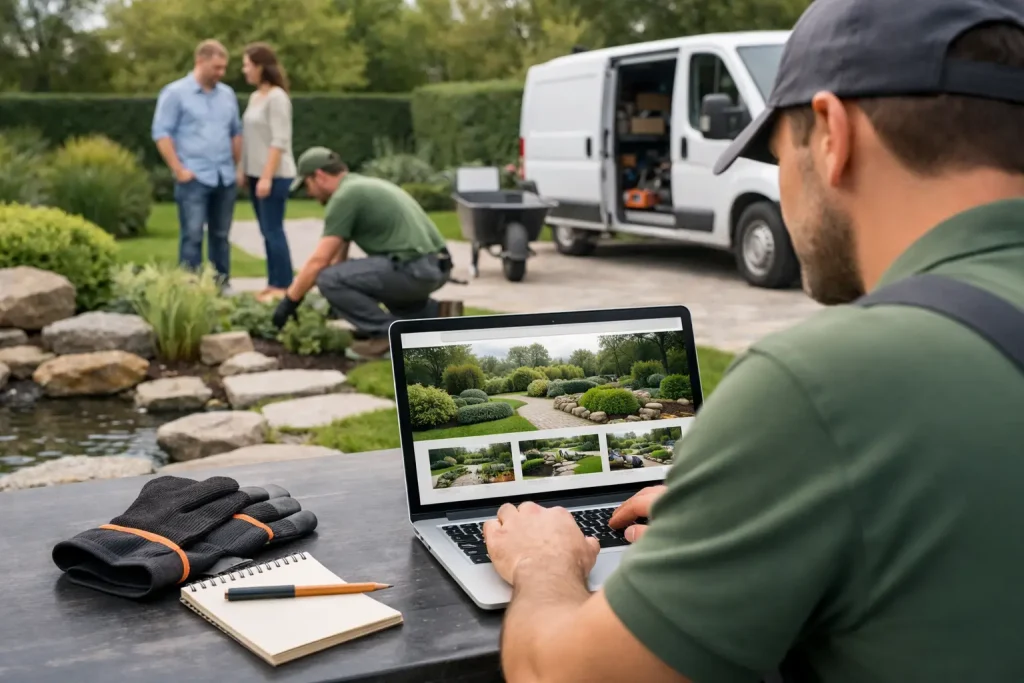
Most landscaping jobs are won before you ever visit the garden. A customer searches online, checks a few businesses, looks at photos, and decides who seems reliable enough to contact. If your business is hard to find, looks dated, or gives people no clear way to ask for a quote, you lose work to someone else. That is why a proper website for landscaper business is not a nice extra. It is part of how you win local jobs.
Landscaping is visual, local, and trust-based. People are not just buying paving, turfing, fencing, or a new patio. They are paying for someone to turn up, understand the job, and do it properly. Your website needs to make that decision easier. It should show what you do, where you work, and how to get in touch without making people think too hard.
What a website for landscaper business should actually do
A lot of trades websites miss the point. They focus too much on design and not enough on enquiries. For a landscaper, the job of the site is simple. It needs to help local customers find you, trust you, and contact you.
That means your website should work well on mobile, because many people will find you on their mobile phone. It should load quickly, because slow sites get abandoned. It should clearly list your services, because not every visitor wants the same job. One person might need regular garden maintenance, while another wants a full garden redesign, decking, or block paving.
Just as importantly, it needs proper quote forms and click-to-call options. If someone has to hunt for your number or guess what to do next, you will lose them. The best trade websites remove friction. They give people a clear next step and make contacting you feel easy.
The pages that matter most
You do not need a huge website packed with waffle. You need the right pages, written clearly.
A strong homepage should say who you are, what you do, and which areas you cover. It should also direct people towards a quote request or phone call straight away. Many landscapers make the mistake of keeping things too vague. If you install patios, fencing, turf, driveways, decking, and garden makeovers, say so plainly.
A services section matters because customers often search for one specific job. They may not be looking for a landscaper in general. They may want a new patio in their back garden, fencing after storm damage, or artificial grass for easier upkeep. Clear service pages help match what they are searching for with what you actually offer.
A gallery or project section is especially useful for landscaping businesses. This is one trade where visuals do a lot of the selling. Before and after photos, tidy project shots, and examples of completed work can give a customer confidence far quicker than a long sales pitch ever will.
You also need a contact page that is simple and complete. Phone number, enquiry form, service area, and basic business details should all be easy to find. If customers cannot work out whether you cover their area, some will move on without asking.
Why local focus matters more than flashy design
Most landscapers do not need a complicated website. They need a site that works for the areas they serve. If your work is local, your website should feel local too.
That means naming the towns, villages, or service areas you actually cover. It means writing in a straightforward way that reflects how customers think when they search. Someone is not usually looking for a creative brand experience. They are looking for a dependable local landscaper who can price the job and turn up when promised.
There is a trade-off here. A highly customised website may look impressive, but it often takes longer, costs more, and adds little if the basics are missing. A simple, professional site with clear services, local coverage, and strong enquiry options will usually do more for a small landscaping business than a flashy build full of features nobody asked for.
What customers want to see before they contact you
When someone lands on your website, they are trying to answer a few practical questions quickly. Do you do the kind of work they need? Are you based nearby? Do you look credible? Is it easy to get a quote?
Your site should answer all four within seconds.
Photos are a big part of this, but not the only part. Customers also want reassurance that they are dealing with a real business. Clear wording, a proper mobile layout, straightforward contact details, and a site that looks current all help. A weak website can make a decent business look disorganised, even when the work itself is excellent.
For landscapers, trust signals matter because many jobs involve larger spend. A full garden project, new paving, or major fencing work is not an impulse buy. People compare options. They look for signs that you are established and easy to deal with. Your website should support that decision, not create doubt.
Common problems with a landscaper website
The biggest issue is often no website at all. Many landscapers rely on word of mouth and social media, which can work for a while, but both are inconsistent. Referrals rise and fall. Social posts disappear quickly. A website gives you a fixed place online that you control.
The next problem is having a site that is out of date. Old photos, missing contact details, poor mobile display, or pages that do not reflect your current services can all put people off. Even if the business is busy and reputable, a neglected website sends the wrong message.
Another common issue is making the site too broad. If everything is lumped together under one generic description, potential customers may not realise you offer exactly what they need. Clear service breakdowns solve that.
Then there is the admin side. Busy tradespeople often do not have time to deal with hosting, edits, forms, updates, and Google setup. That is where many websites stall. They get launched and then forgotten. For a small business owner, the best setup is usually one that removes the technical work and keeps the site maintained properly month after month.
Speed and simplicity matter
If getting a website feels like a project that will drag on for months, many landscapers put it off. Fair enough. You are running jobs, pricing work, ordering materials, and managing the day-to-day. You do not need another headache.
That is why a practical setup matters more than endless options. A website should be quick to get live, affordable to keep running, and built around getting enquiries. For many trades businesses, a monthly service model makes more sense than a big upfront cost. It keeps things predictable and removes the usual hassle around updates and support.
This is also where trade-focused providers have an advantage. A business that understands local service trades already knows what needs to be on the site, how customers behave, and what helps convert visits into enquiries. You are not paying for theory. You are paying to get something useful live quickly.
How to judge whether your current site is doing its job
You do not need analytics jargon to spot whether a website is helping. Ask a few simple questions.
Can a customer tell in under ten seconds what you do and where you work? Can they view your work easily on mobile? Is there a clear button or form to request a quote? Are your services spelled out properly? Does the site look current and trustworthy?
If the answer is no to a couple of those, the site is probably costing you enquiries.
It also helps to think about how customers behave outside working hours. Plenty of people search in the evening, at weekends, or while on a break at work. If your website is doing its job, it can keep bringing in enquiries even when you are on site or unavailable to answer the phone. That alone makes it valuable.
A better website means fewer missed jobs
A good website will not replace solid work or local reputation. It supports both. It gives new customers a simple way to find you, check your work, and make contact. It also reduces your reliance on third-party lead platforms, where every enquiry can come with extra cost and no guarantee of quality.
For a landscaper, that matters. You want more direct enquiries from people in your area who are already looking for the services you provide. A clear, well-managed website helps create that.
If you are busy on the tools, the right answer is rarely to build something complicated. It is to get a straightforward site live, make sure it reflects your business properly, and keep it working. That is the practical route. And for most local landscapers, it is the one that brings the best return.
The main thing is not to wait until work goes quiet before sorting it out. A website works best when it is already in place, already showing your business properly, and already making it easy for the next customer to get in touch.